Crimson Legacy: The Infinite Allure and Expert Guide to the Ruby
T here is a specific, visceral moment when you first hold a high-quality ruby against the light. It isn’t just a stone; it is a concentrated pulse of color. Unlike the icy detachment of a diamond, a ruby feels warm, almost rhythmic, as if it holds a trapped, flickering ember from a long-forgotten fire. This is the “King of Gems,” a title it has defended for millennia across every major civilization from the Mogok Valley to the royal courts of Europe.
For the modern collector, the ruby represents the ultimate intersection of investment and emotion. However, the path to owning a true “pigeon blood” masterpiece is fraught with synthetic lookalikes and deceptive treatments. At Veyrael, we believe luxury is defined by transparency. In this guide, we will strip away the mystery of the crimson legacy, offering you the sensory knowledge and technical expertise required to secure a gemstone that is as authentic as it is breathtaking.
“It is a stone built to endure the friction of centuries — the premier choice for 15th and 40th wedding anniversaries.”
The Blood of the Earth: A History of the “Ratnaraj”
Long before it was a staple of high-jewelry houses like Cartier, the ruby was known in ancient Sanskrit as ratnaraj, or the “king of precious stones.” It was more than an accessory; it was a physical manifestation of power and protection.
Ancient Burmese warriors were so convinced of the ruby’s protective energy that they didn’t just wear the stones — they inserted them under their skin. They believed the gem would become one with their flesh, granting invincibility against enemy blades. In the medieval world, the stone was thought to grow dark when danger neared, acting as a silent sentinel for the monarchs who wore them in their crowns.
Even today, when you feel the weight of a ruby — a mineral of the corundum family with a formidable hardness of 9 on the Mohs scale — you are feeling one of the most durable substances on Earth. It is a stone built to endure the friction of centuries, which is why it remains the premier choice for 15th and 40th wedding anniversaries.
Deciphering the Crimson: The 4Cs of Ruby Selection
When buying a ruby, you are not just buying a stone; you are buying “the red.” In the world of colored gemstones, color is the absolute dictator of value.
-
Color: The Pursuit of “Pigeon Blood”
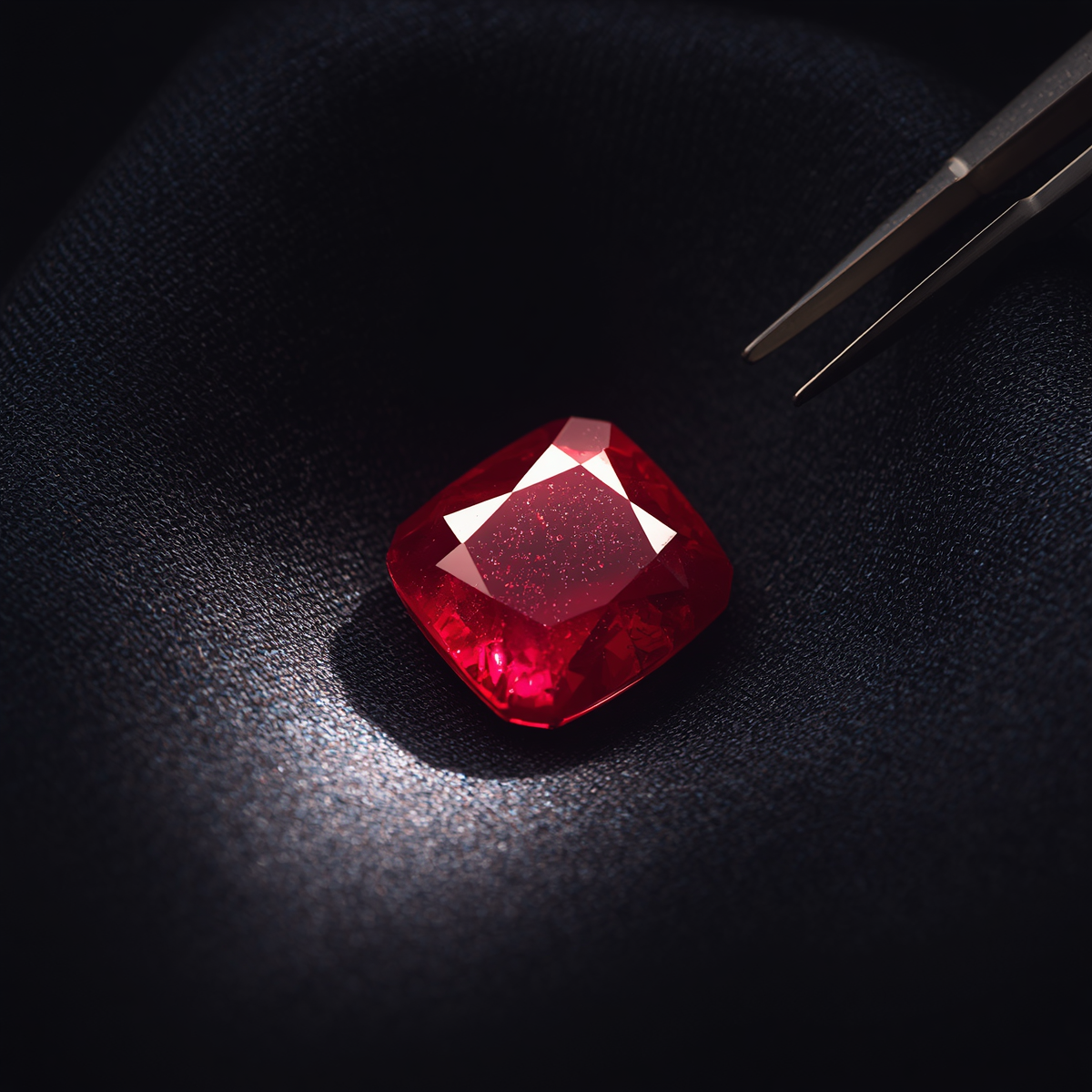
The most coveted rubies possess a hue known as “pigeon blood” — a vivid, deep red with a subtle hint of blue. To the eye, this creates a secondary glow that makes the stone appear to be lit from within.
The Nuance: As the color drifts toward orange or purple, the value begins to soften. The Glow: High-quality rubies often exhibit fluorescence, glowing a bright, ghostly red under ultraviolet light — a trait particularly common in stones of Burmese origin. -
Clarity: The “Silk” of Authenticity
In the diamond world, inclusions are flaws. In the ruby world, they are a fingerprint. Almost every natural ruby contains “silk” — microscopic rutile needles that create a soft, velvety sheen.
The Pro Tip: If a ruby is “loop-clean” (perfectly clear under magnification) and the price is modest, it is almost certainly a synthetic or lab-grown stone. Natural rubies should be “eye-clean” — meaning no major cracks or clouds are visible to the naked eye — but a total lack of internal character is a red flag. -
Cut: Fueling the Fire
A ruby’s cut determines how light dances through its crystal structure. Because rubies are dichroic — showing different shades of red and orange-red from different angles — a master cutter will orient the stone to showcase the most intense red through the table. Look for a cut that avoids “extinction” (dark, dead spots) or “windowing” (pale, see-through areas in the center). -
Carat: Rarity in Scale
While you can find 10-carat diamonds with relative ease, a gem-quality ruby over 5 carats is an extraordinary rarity. This scarcity drives auction prices for large rubies higher than almost any other gemstone, sometimes even eclipsing the per-carat price of colorless diamonds.
Inspect Your Jewelry Live
Want to check this piece for authentic hallmarks, facet alignments, or hidden inclusions right now? Use our complimentary digital macro tool on your smartphone.
Launch Live Mobile LoupeGeographic Pedigree: Why Origin Matters
In the luxury market, a ruby’s “birthplace” can double its price. However, as the GIA warns, origin does not always guarantee quality.
| Origin | Key Characteristics | Market Value |
|---|---|---|
| Myanmar (Burma) | High chromium content, signature “pigeon blood” glow, strong fluorescence under UV | ⭐ Highest — Gold Standard |
| Mozambique | High-quality, transparent rubies; increasingly competitive with Burmese stones | ⭐⭐⭐ Very High |
| Thailand | Higher iron content; darker, brownish-red tone; lacks the “fire” of Burmese stones | ⭐⭐ Moderate |
| Sri Lanka | Pinker hues; often lean toward the sapphire category; lighter color saturation | ⭐⭐ Moderate |
Consumer Protection: Avoiding the “Lead-Glass” Trap
This is where the unsuspecting buyer can make a five-figure mistake. To enhance the appearance of low-grade stones, some manufacturers use lead-glass filling.
These stones are essentially “Frankengems” — natural ruby material that has been infused with glass to hide cracks. While they look beautiful in a display case, they are fragile. A simple repair or even some household cleaners can cause the glass to erode, leaving you with a shattered, dull rock.
The Veyrael Rule of Thumb: Always ask for an independent lab report (such as from the GIA). If a jeweler cannot provide one, or if they claim the stone is “natural” but refuse to disclose treatments, walk away. Most rubies undergo simple heat treatment to improve color — this is a standard, stable industry practice that must be disclosed. However, glass-filled or surface-diffused stones should be priced significantly lower than their heated counterparts.
Design and Care: Mounting the Flame
For an engagement ring or a legacy piece, the choice of metal is a textural decision.
Platinum or White Gold: These cool metals create a “window” effect, allowing the ruby’s red to pop with clinical brilliance.
Yellow or Rose Gold: These metals pull out the warmth of the stone, creating a vintage, royal aesthetic that feels substantial and classic.
To care for your ruby, avoid the harsh vibrations of ultrasonic cleaners if your stone has fractures or treatments. Instead, use the tactile simplicity of warm, sudsy water and a soft-bristled brush to keep the “King of Gems” gleaming.
Frequently Asked Questions
-
Can I wear a ruby ring every day?
Yes. With a hardness of 9, rubies are second only to diamonds in durability, making them perfect for daily wear. -
What is the difference between a ruby and a pink sapphire?
They are the same mineral (corundum). The only difference is the saturation of red. If the stone is more pink than red, it is classified as a sapphire. -
Are lab-grown rubies “fake”?
No. Lab-grown (or “created”) rubies have the same chemical and physical properties as mined stones. They are a beautiful, ethical, and affordable alternative, provided they are clearly disclosed as man-made.
Conclusion: The Investment of a Lifetime
Choosing a ruby is an exercise in both the heart and the mind. It is a stone that demands you look closer, past the surface and into the “silk” and fire of its depths. Whether you are drawn to the protective legends of the ancient world or the sheer, unapologetic luxury of a “pigeon blood” centerpiece, the ruby remains the ultimate statement of passion.
Invest in quality, insist on transparency, and you will own a fragment of the earth’s most vibrant history.