Beyond the Brilliance: The Modern Tastemaker’s Guide to Moissanite vs. Diamond
Selecting a gemstone for a significant life milestone—be it an engagement, an anniversary, or a personal achievement—is rarely just a financial transaction
It is an emotional investment in a symbol that will, quite literally, be worn every single day. For decades, the diamond has stood as the undisputed titan of the jewelry world, but a new era of “conscious luxury” has brought Moissanite into the spotlight.
At Veyrael, we believe that luxury is defined by informed choice, not just a price tag. The debate of Moissanite vs. Diamond isn’t about which stone is “better” in an absolute sense; it is about which stone aligns with your aesthetic preferences, your ethical values, and your financial goals.
In this comprehensive guide, we peel back the marketing layers to reveal the scientific and practical truths of these two spectacular jewels.
The Origin Stories: From Deep Earth to Stardust
To understand the soul of a gemstone, one must look at its origins. A Diamond is a marvel of subterranean pressure—a single crystal of pure carbon forged over billions of years deep within the Earth’s mantle.
Whether mined from the earth or grown in a lab using High Pressure High Temperature (HPHT) or Chemical Vapor Deposition (CVD), a diamond remains chemically and physically identical: the hardest natural substance known to man.
Moissanite, by contrast, has a history that reads like science fiction. Originally discovered in 1893 by Nobel Prize-winning chemist Henri Moissan, the first crystals were found within a meteorite crater in Arizona. Natural moissanite is so vanishingly rare that it is effectively non-existent in the commercial market.
The moissanite you see in luxury showrooms today is the result of meticulous laboratory craftsmanship. It is composed of silicon carbide (SiC), a material that—while visually similar to diamond—possesses an entirely different atomic structure. While some may dismiss it as a “substitute,” the modern gemological community recognizes it as a distinct, high-performance jewel with its own unique optical signature.
The Optical Signature: Fire, Brilliance, and the “Disco Ball” Effect
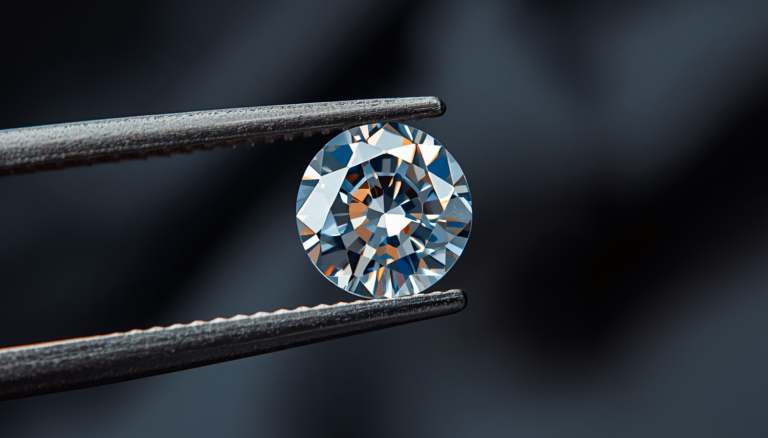
When you hold a gemstone to the light, you are witnessing a complex dance of physics. The most striking difference between moissanite and diamond lies in their refractive index and dispersion.
1. The Fire of Moissanite
If you crave high-octane sparkle, moissanite is unparalleled. It possesses a refractive index of 2.65 to 2.69, which is actually higher than that of a diamond (2.42). More importantly, its dispersion—the ability to split white light into a rainbow of colors—is nearly 2.4 times greater than a diamond’s.
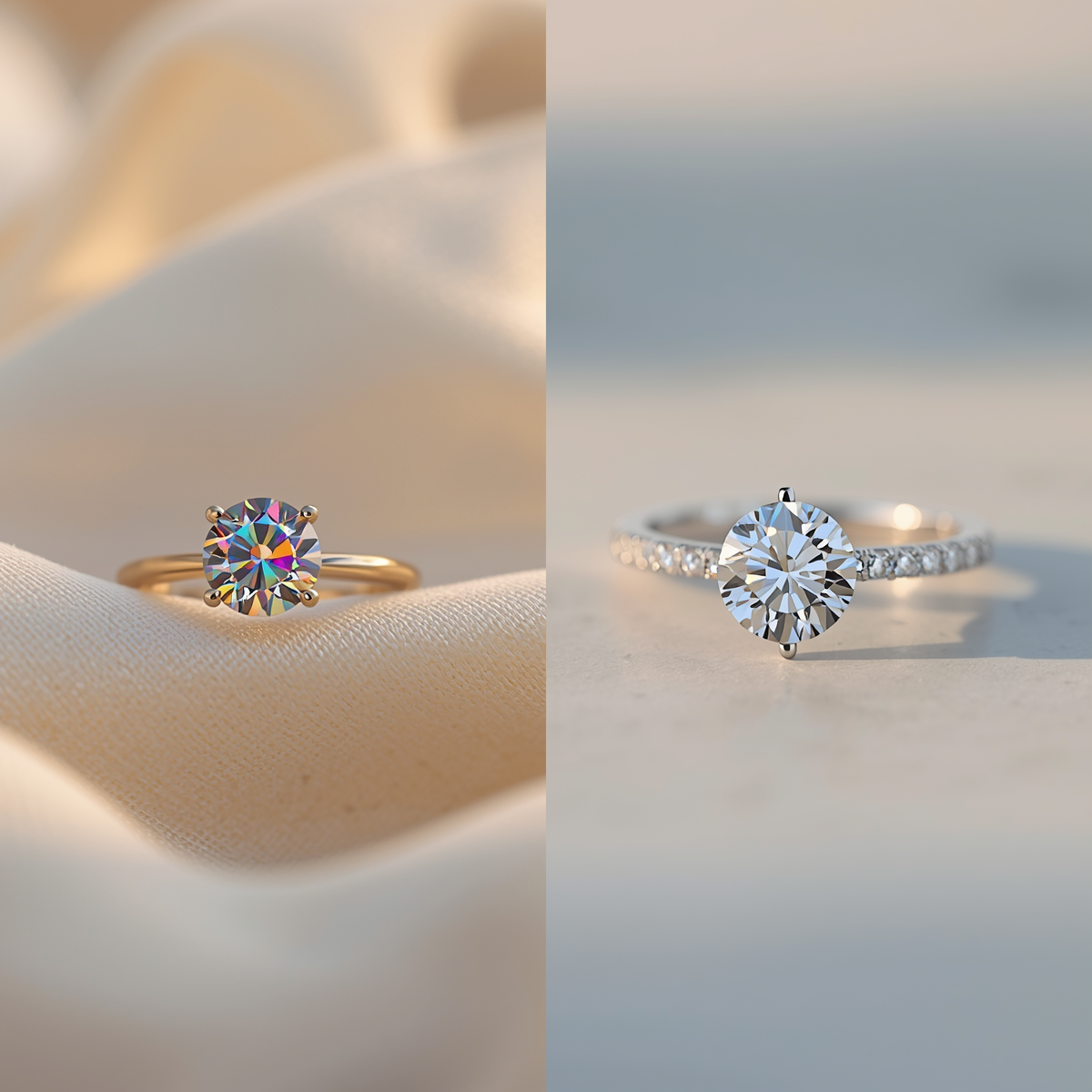
On the other hand, this translates to “fire.” Moissanite throws vivid, multi-colored flashes that some collectors affectionately call the “disco ball effect”. In candlelit restaurants or under LED spotlights, a moissanite will often look more “alive” and colorful than a diamond of the same size.
2. The Classic Brilliance of Diamond
Diamonds are celebrated for their “scintillation”—a more restrained, sophisticated play of white and black light. While a diamond still displays fire, its primary appeal is its crisp, white light return. For those who prefer a traditional, icy look that feels “steady” rather than “fiery,” the diamond remains the gold standard.
Expert Tip: If you are trying to tell them apart, look at the stone under direct sunlight. The rainbow flashes in a moissanite will be much more pronounced, whereas the diamond will show more white light brilliance.
Durability in the Real World: Hardness vs. Toughness
A common misconception in the jewelry world is that “hardness” is the only measure of durability. In reality, we must consider both Hardness (scratch resistance) and Toughness (resistance to chipping).
- Hardness: Diamond is the king of the Mohs scale at a perfect 10. Moissanite follows incredibly closely at 9.25. To put this in perspective, moissanite is harder than sapphires, rubies, and emeralds. In everyday life, neither stone is likely to be scratched by common household objects like keys or countertops.
- Toughness: Interestingly, moissanite has a structural advantage. Diamonds have “cleavage planes”—internal lines of weakness where the stone can split if hit at exactly the right angle. Moissanite lacks these planes, making it exceptionally resilient against chipping and daily knocks.
- Heat Resistance: In extreme scenarios, such as a house fire or a jeweler’s torch during a repair, moissanite actually outperforms diamond. While a diamond can vaporize at temperatures around 1100°C, moissanite remains intact and maintains its brilliance.
Practical Buying Advice: If you plan on stacking rings (e.g., an engagement ring with an eternity band), be cautious. Because a diamond is harder than a moissanite, a diamond band can gradually scratch the side of a moissanite center stone over years of contact. If stacking, ensure your settings are designed to prevent the stones from rubbing directly against one another.
For a deeper dive into diamond heritage, explore The Eternal Brilliance: A Master Guide to Diamond History, Symbolism, and Curation.Investment Value and the Price Transparency Gap
This is where the “luxury” of moissanite becomes most apparent. The price discrepancy between the two stones is staggering, especially as you move into larger carat weights.
The Carat-for-Carat Breakdown
On average, a high-quality moissanite costs between 5% to 15% of a natural diamond and roughly 25% to 40% of a lab-grown diamond.
- The $1,000 Milestone: For a $1,000 budget, you might secure a modest 0.50-carat natural diamond. For that same $1,000, you could purchase a stunning 7mm moissanite, which visually equates to a 1.5-carat diamond.
The Resale Reality
If you view your jewelry as a financial asset to be liquidated later, the diamond—specifically the natural diamond—is the superior choice.
Natural diamonds typically retain 30% to 50% of their retail value on the secondary market. Moissanite, being a lab-created product with no inherent scarcity, has a much lower resale value, often fetching only 5% to 15% of its original price.
At Veyrael, we advise clients to buy jewelry for the joy of wearing it. However, if inheritance and legacy value are your primary drivers, the traditional diamond market offers more stability.
| Feature | Moissanite | Diamond |
|---|---|---|
| Hardness | 9.25 | 10 |
| Fire | Extremely High | Moderate |
| Resale Value | Low | Moderate – High |
| Origin | Lab – created | Natural or Lab |
| Price | Budget – friendly | Premium |
| Ethical Concerns | Minimal | Depends on sourcing |
Ethical and Sustainable Considerations
In the modern landscape, the “why” behind a purchase is just as important as the “what.”
- Sustainability: Because moissanite is exclusively lab-grown, it carries a significantly smaller environmental footprint than mined diamonds. It requires no large-scale earth displacement and avoids the complex ethical histories often associated with certain diamond mining regions.
- Traceability: For those who want 100% certainty regarding the origins of their stone, lab-created options (both moissanite and lab diamonds) offer a transparent supply chain that is difficult to replicate with earth-mined stones.
Certification Matters
When purchasing either moissanite or diamond jewelry online, always verify whether the stone includes certification from a recognized gemological laboratory.
For diamonds, respected authorities include:
- GIA
- IGI
- AGS
For moissanite, reputable brands may include certificates of authenticity detailing:
- color grade
- clarity
- cut precision
- carat equivalent sizing
Common Myths: Will it Look “Fake”?
One of the most persistent fears among first-time buyers is that moissanite will look like “glass” or a “cheap imitation.” This couldn’t be further from the truth.
Modern moissanites are cut with the same precision and artistry as fine diamonds. To the untrained eye, a high-quality, colorless (D-E-F) moissanite is virtually indistinguishable from a diamond in passing. It is only under the close scrutiny of a jeweler’s loupe or a specialized electronic tester that the differences become clear.
Frequently Asked Questions
Does moissanite get cloudy over time?
No. Unlike cubic zirconia (CZ), which is porous and can absorb oils or become cloudy, moissanite is a stable crystalline structure. If your moissanite looks dull, it is likely just a buildup of surface oils from lotions or soaps. A simple cleaning with warm water and mild soap will restore its original brilliance.
Can a jeweler’s diamond tester detect moissanite?
Older thermal-only testers will often mistake moissanite for diamond because both stones conduct heat similarly. However, modern “combination testers” that measure both thermal and electrical conductivity can easily distinguish between the two in seconds.
Is moissanite considered a “real” gemstone?
Yes. It is a real, lab-created gemstone with its own unique chemical formula (SiC). It is not “fake” diamond; it is its own entity, just as a sapphire is distinct from a ruby.
If ethical sourcing matters to you, read Beyond the Sparkle: The Veyrael Masterclass on Ethical Diamond Procurement.Final Thoughts: Which Stone Fits Your Story?
The choice between moissanite and diamond is a reflection of your priorities.
- Choose Moissanite if: You value maximum sparkle, want the largest possible stone for your budget, or prioritize a 100% conflict-free, eco-conscious origin.
- Choose Diamond if: You value tradition, want a stone with high resale/inheritance value, or prefer the classic, understated “white light” brilliance of a natural gem.
In the end, both gemstones represent permanence, beauty, and personal meaning. Whether it fell from the stars or was forged in the earth, the true value of a gemstone lies in the story it becomes part of.
Bibliography & References
- Glazed Diamonds. “Moissanite vs Diamond Properties: Expert Guide.” (2025).
- Sophia Jewelers. “Moissanite vs Diamond: The Complete 101 Comparison Guide.” (2026).
- International Gem Society (IGS). “Moissanite vs Diamond: Ultimate Comparison Guide.” (2025).
- Article Excerpt. “Moissanite: The Resilient Brilliance of an Eternal Jewel.”
- Elegant Moissanite. “Your Moissanite vs Diamond Guide Starts Here.” (2026).