Veyrael · Pearl Buying Guide · 2025
Freshwater vs. Saltwater Pearls: What Nobody Tells You Before You Buy
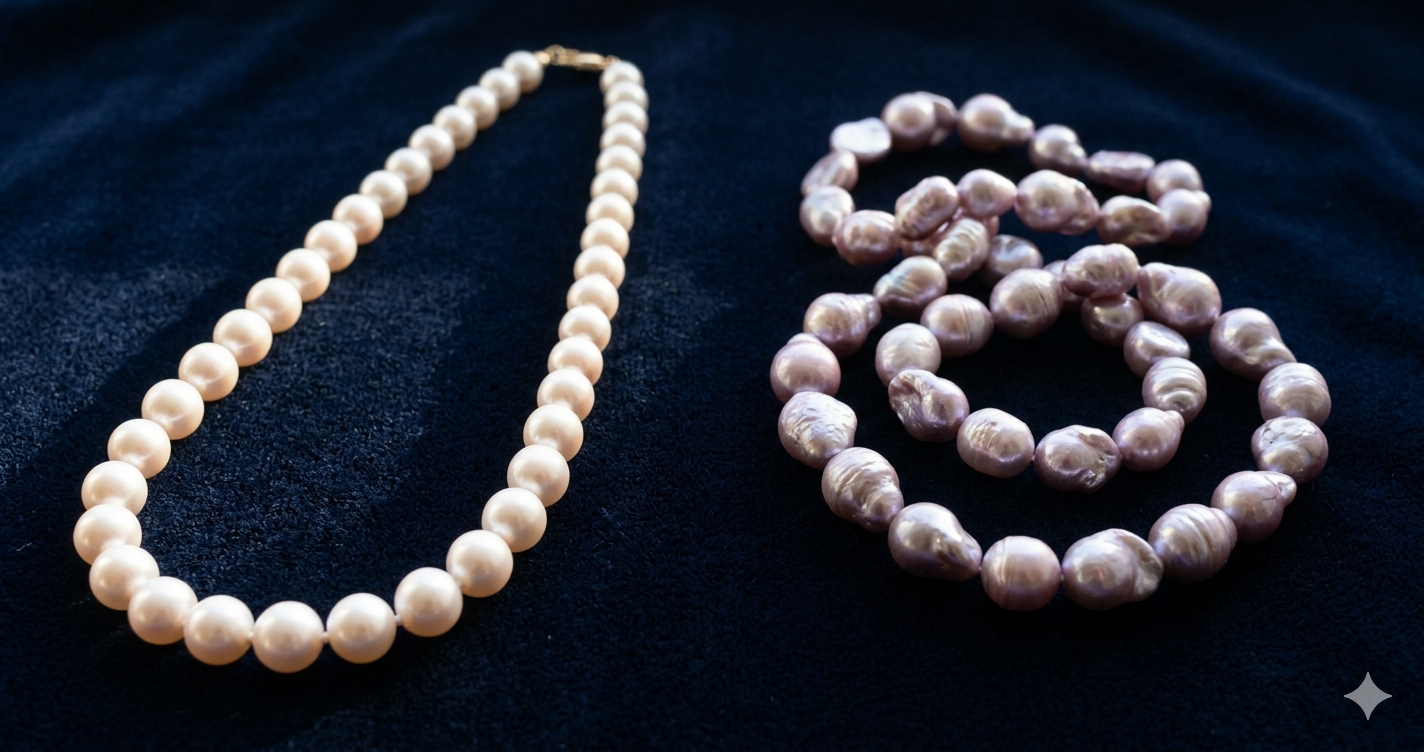
P ick up a strand of high-quality saltwater pearls and feel it settle against your palm — cool, weighty, impossibly smooth. Now hold a freshwater baroque pearl up to the light and watch how its surface shifts from cream to blush to the faintest whisper of lavender. Both are undeniably beautiful. Both are unquestionably real. And yet they could not be more different in origin, character, or price.
If you have ever stood at a jewelry counter wondering why one strand of pearls costs $85 and another costs $8,500 — this guide is for you. The pearl market is full of mystifying terminology, quiet misrepresentations, and genuine surprises for the uninitiated buyer. At Veyrael, we believe the best jewelry purchase is an educated one. So let us walk you through everything that separates a freshwater pearl from a saltwater pearl, and help you decide which belongs around your neck.
“Both freshwater and saltwater pearls are equally real — the difference lies in their origin, their maker, and the story each one carries.”
The Miracle of Nacre: How Every Pearl Begins
Every pearl — regardless of whether it forms in a Tahitian lagoon or a Chinese river farm — begins the same way. A foreign irritant, whether a grain of sand or a piece of implanted shell bead, finds its way into the soft tissue of a mollusk. The creature responds instinctively, coating the intruder in smooth, luminescent layers of a substance called nacre — commonly known as mother-of-pearl. Layer upon patient layer, the nacre builds up over months and years until the irritant is entombed in the gem we know as a pearl.
This biological process is the same whether the mollusk lives in the ocean or a mountain lake. What changes everything is who does the building.
The Fundamental Difference: Oyster vs. Mussel
Saltwater pearls are produced by oysters living in the open ocean — in the warm lagoons of French Polynesia, the cool coastal waters of Japan, and the remote seas surrounding Australia and Indonesia. These are highly sensitive creatures. A single oyster typically yields just one pearl per harvest cycle, which is precisely why saltwater pearls carry the price premium they do.
Freshwater pearls, by contrast, come from mussels — freshwater bivalves that burrow into the sandy beds of rivers, lakes, and ponds. China produces the vast majority of the world’s freshwater pearls. And here is where the economics shift dramatically: a single freshwater mussel can produce up to 30 pearls at one time, versus the saltwater oyster’s solitary output. Greater supply means lower price — and that is the simplest explanation for why a freshwater pearl necklace can cost a fraction of its saltwater equivalent.
In most regions today, pearl harvesting from wild mollusks is either heavily regulated or outright illegal due to the ecological damage it causes to river ecosystems. Both types are now farmed — a process known as pearl cultivation — which has made fine pearls accessible to a far wider market than was possible a century ago.
Side by Side: The Six Key Differences
Once you know what to look for, the differences between a freshwater and saltwater pearl become unmistakable. Here is how they compare across the factors that matter most to a buyer.
| Factor | Freshwater Pearl | Saltwater Pearl |
|---|---|---|
| Producer | Freshwater mussel | Saltwater oyster |
| Shape | Off-round, baroque, egg, button | Round to near-round |
| Luster | Soft, silky, subdued glow | High mirror-like brilliance |
| Nacre | Thick — solid nacre throughout | Thinner — over a bead nucleus |
| Color Range | White, cream, pink, lavender, copper | White, cream, black, gold, silver |
| Durability | Excellent — solid nacre resists chipping | Good — nacre thickness varies |
| Price | Affordable to mid-range | Mid-range to ultra-luxury |
Luster: The Quality That Separates Good from Extraordinary
Of all the differences between freshwater and saltwater pearls, luster is the one that hits you first. Saltwater pearls tend to have a higher luster, reflecting light more brilliantly due to their thinner layers of nacre and bead nucleus. Freshwater pearls often have a softer, more subdued glow because their nacre is thicker but less compact.
Think of the difference this way: a saltwater Akoya pearl held to the light looks almost like a tiny mirror — you can see the room reflected in its surface. A high-quality freshwater pearl has a gentler, satiny radiance that flatters the skin without demanding attention. Neither is inferior. They simply speak different languages of beauty.
Shape and Color: Where Freshwater Pearls Surprise You
The traditional image of a pearl — perfectly round, luminously white — belongs to the saltwater world. Freshwater pearls are available in round, oval, button, and baroque shapes. Their versatility makes them ideal for modern and classic jewelry designs. The baroque shapes in particular — irregular, organic, completely one-of-a-kind — have become a serious trend in contemporary fine jewelry, precisely because no two pieces can ever look the same.
On the color front, freshwater pearls are genuinely remarkable. Because the mussel’s nacre takes on the hue of its own shell, freshwater pearls can range from soft white and ivory to blush pink, peach, lavender, and even a warm copper that looks extraordinary against warm skin tones. Saltwater pearls offer their own color drama — the deep charcoal of Tahitian pearls and the luminous gold of South Sea varieties are in a category of their own — but freshwater pearls simply offer more variety at accessible prices.
Durability: The Counterintuitive Winner
Here is the fact that surprises most buyers: freshwater pearls, with their thicker nacre, are generally more durable and resistant to chipping, making them great for everyday wear. Because a freshwater pearl is composed almost entirely of solid nacre — with no bead nucleus inside — there is nothing to peel, nothing to separate. Because they are solid nacre all the way through, they are less likely to get chipped or have their outer layers peel off.
Saltwater pearls, by contrast, are built around a bead nucleus and coated in nacre. The thickness of that nacre coat varies by producer and harvest conditions. When buying saltwater pearls, always ask about nacre thickness — thin nacre on a cultured saltwater pearl can begin to peel within a few years of daily wear. A good jeweler will be able to show you this under magnification.
The Three Saltwater Pearl Varieties You Should Know
Akoya Pearls — The quintessential “bridal” pearl. Produced primarily in Japan, Akoya pearls are prized for their exceptional roundness and high-mirror luster. They typically range from 6–9mm and come in white and cream with delicate rose or silver overtones. These are the pearls most people picture when they think of a classic pearl necklace.
Tahitian Pearls — Grown in the black-lipped oyster of French Polynesia, these are the only naturally dark pearls in the world. Their color palette ranges from charcoal grey to deep green, peacock blue, and aubergine — colors that have made them a favorite of modern designers and collectors.
South Sea Pearls — The largest and rarest of all cultured pearls, grown in the golden-lipped and silver-lipped Pinctada maxima oyster in Australia, Indonesia, and the Philippines. Their warm golden and silver tones, combined with sizes that can reach 20mm, place them at the very pinnacle of pearl luxury.
Practical Buying Advice: What to Look For
Veyrael Tip: The single most reliable indicator of pearl quality — in both freshwater and saltwater varieties — is luster. Hold the pearl under good natural light. You should see a clear, deep reflection in the surface. A dull, chalky, or flat appearance indicates either thin nacre or low-grade cultivation. Never buy pearls you cannot examine closely under light.
- Check the nacre thickness on saltwater pearls — Ask your jeweler to show the pearl under magnification at the drill hole. You should see a clear, thick layer of nacre over the bead. When buying saltwater pearls, make sure the nacre is thick enough that it will not peel off within the next few years.
- Buy from a certified dealer — It is advisable to buy from a trusted jeweler who provides certification for the pearls. This protects you against misrepresentation and gives you recourse if quality is not as described.
- Compare under multiple light sources — Take a good look at pearls under bright light to see how they shine and if there are any blemishes on the surface. Do not be afraid to put different types right next to each other. This is the fastest way to understand quality differences first-hand.
- Know your budget before you walk in — Both freshwater and saltwater pearls are beautiful in their own ways and have different things to offer jewelry lovers. Saltwater pearls have incredible luster and their gem-quality pearls embody high luxury. Freshwater pearls offer great budget compatibility and a range of colors that are both tempting and lovely.
- Size matters more than you think for price — Once pearls hit 8mm they will double in price. If you want a substantial strand without a substantial price tag, high-quality freshwater pearls in the 7–8mm range offer extraordinary value.
Veyrael Tools
Before you buy any gemstone jewelry, inspect it yourself with our free tools — no expertise required.
- 🔍 Diamond Size Visualizer — See exactly how different carat weights appear on your finger before committing
- 💎 Live Jewelry Loupe — Use your phone camera to inspect pearl luster, nacre, and surface quality in real time
Frequently Asked Questions
-
Are freshwater pearls real pearls?
Absolutely. This is one of the most persistent misconceptions in the jewelry world. Both freshwater and saltwater pearls are produced naturally by living mollusks through the same biological process of nacre secretion. A freshwater pearl is every bit as genuine as an Akoya or South Sea pearl. -
Which type of pearl is more durable for everyday wear?
Freshwater pearls are better for most jewelry buyers because they are more affordable, versatile, durable, and available in a wide range of shapes and sizes. Their solid nacre composition makes them more resistant to chipping and surface damage over time. -
How should I care for my pearls?
Both types require gentle care to maintain their shine and luster. Clean them with a soft cloth and store them in a soft pouch away from direct sunlight and harsh chemicals. Avoid wearing them during physical activities or while applying lotions and perfumes. -
Which is better — freshwater or saltwater?
This is a very subjective question, and the answer really depends on you, the buyer, and what you are looking for. If you want maximum luster and a perfectly round stone for a classic occasion piece, saltwater. If you want versatility, durability, color variety, and extraordinary value for everyday elegance, freshwater.
Continue Reading on Veyrael
The Bottom Line
There is no universally “better” pearl — there is only the right pearl for your intention, your budget, and your personal sense of beauty. A perfectly matched Akoya strand is one of the most enduring symbols of classic elegance ever made. A strand of lavender baroque freshwater pearls is one of the most individual and unexpected pieces of jewelry a modern woman can own.
What matters is that you walk into any pearl purchase with your eyes open — knowing the difference between luster and glow, between nacre thickness and bead depth, between the rarity of ocean-grown gems and the accessible artistry of river pearls. And if you ever want to inspect a piece before you buy, our Live Jewelry Loupe lets you do exactly that — from the palm of your hand.